Instance types (Flavor)
Management of the leased pool of computational resources for the project takes place by combining the use of different types of instances.
Warning
In SIM-Cloud, only resource configurations (types of instances) that have been defined in advance are available for instances. It is not currently possible to create a configuration with an undefined ratio of processor cores to storage.
The instance type (flavor) describes the configuration of computational resources:
the number of virtual processors (vCPU);
the volume of random-access memory (RAM);
and can be assigned to an instance at the moment of its creation or can be changed after it has been launched.
The instance types available in the system fully cover the majority of requirements for the deployment of modern systems and services. All available templates satisfy the requirements of NUMA topology for the utilization of the processing possibilities of hypervisors, which provides the maximum efficiency of computational resources to the user.
When you create an instance, the type (flavor) of the instance specified by you automatically determines the appropriate host hypervisor in terms of technical requirements, and that is where your instance is situated.
Each type of instance offers different computing possibilities, not only in terms of the ratio of vCPUs to RAM but also of their qualitative indicators, including the base clock speed of the virtual processors. SIM-Cloud offers the guaranteed computational resources of a hypervisor, such as a processor and storage for a specific instance based on the selected type or flavor.
To assist you, we have grouped the types of instances into families based on their computational capabilities and capacity.
4 groups of instance types are available to users of SIM-Cloud:
Power Flavors.
Memory Optimized Flavors.
Standard Flavors.
vGPU Flavors.
Power Flavors
Power Flavors (p1.*) |
|||
Flavor |
vCPU (3,3GHz) |
RAM (GB) |
Description |
p1.C2R4 |
2 |
4 |
PowerCPU |
p1.C2R8 |
2 |
8 |
PowerCPU |
p1.C2R16 |
2 |
16 |
PowerCPU |
p1.C4R8 |
4 |
8 |
PowerCPU |
p1.C4R16 |
4 |
16 |
PowerCPU |
p1.C4R24 |
4 |
24 |
PowerCPU |
p1.C4R32 |
4 |
32 |
PowerCPU |
p1.C6R12 |
6 |
12 |
PowerCPU |
p1.C6R16 |
6 |
16 |
PowerCPU |
p1.C6R24 |
6 |
24 |
PowerCPU |
p1.C6R32 |
6 |
32 |
PowerCPU |
p1.C6R64 |
6 |
64 |
PowerCPU |
p1.C6R96 |
6 |
96 |
PowerCPU |
p1.C8R16 |
8 |
16 |
PowerCPU |
p1.C8R32 |
8 |
32 |
PowerCPU |
p1.C8R64 |
8 |
64 |
PowerCPU |
p1.C8R96 |
8 |
96 |
PowerCPU |
p1.C12R32 |
12 |
32 |
PowerCPU |
p1.C12R64 |
12 |
64 |
PowerCPU |
p1.C12R96 |
12 |
96 |
PowerCPU |
p1.C12R128 |
12 |
128 |
PowerCPU |
p1.C12R192 |
12 |
192 |
PowerCPU |
p1.C16R64 |
16 |
64 |
PowerCPU |
p1.C16R96 |
16 |
96 |
PowerCPU |
p1.C16R128 |
16 |
128 |
PowerCPU |
p1.C20R96 |
20 |
96 |
PowerCPU |
p1.C20R128 |
20 |
128 |
PowerCPU |
p1.C24R128 |
24 |
128 |
PowerCPU |
Memory Optimized Flavors
Memory Optimized Flavors (p1mo.*) |
|||
Flavor |
vCPU (3.3GHz) |
RAM (GB) |
Description |
p1mo.C2R32 |
2 |
32 |
Memory optimized |
p1mo.C4R64 |
4 |
64 |
Memory optimized |
p1mo.C6R96 |
6 |
96 |
Memory optimized |
p1mo.C8R128 |
8 |
128 |
Memory optimized |
p1mo.C12R192 |
12 |
192 |
Memory optimized |
p1mo.C16R256 |
16 |
256 |
Memory optimized |
p1mo.C20R320 |
20 |
320 |
Memory optimized |
p1mo.C24R384 |
24 |
384 |
Memory optimized |
p1mo.C28R448 |
28 |
448 |
Memory optimized |
p1mo.C32R512 |
32 |
512 |
Memory optimized |
Standard Flavors
Standard Flavors |
|||
Flavor |
vCPU (2,3-2,6GHz) |
RAM (GB) |
Description |
SIM-C1R1 |
1 |
1 |
StdCPU |
SIM-C1R2 |
1 |
2 |
StdCPU |
SIM-C1R4 |
1 |
4 |
StdCPU |
SIM-C2R4 |
2 |
4 |
StdCPU |
SIM-C2R8 |
2 |
8 |
StdCPU |
SIM-C2R16 |
2 |
16 |
StdCPU |
SIM-C4R8 |
4 |
8 |
StdCPU |
SIM-C4R16 |
4 |
16 |
StdCPU |
SIM-C4R24 |
4 |
24 |
StdCPU |
SIM-C4R32 |
4 |
32 |
StdCPU |
SIM-C6R12 |
6 |
12 |
StdCPU |
SIM-C6R16 |
6 |
16 |
StdCPU |
SIM-C6R24 |
6 |
24 |
StdCPU |
SIM-C6R32 |
6 |
32 |
StdCPU |
SIM-C6R64 |
6 |
64 |
StdCPU |
SIM-C8R16 |
8 |
16 |
StdCPU |
SIM-C8R32 |
8 |
32 |
StdCPU |
SIM-C8R64 |
8 |
64 |
StdCPU |
SIM-C8R96 |
8 |
96 |
StdCPU |
SIM-C12R32 |
12 |
32 |
StdCPU |
SIM-C12R64 |
12 |
64 |
StdCPU |
SIM-C12R96 |
12 |
96 |
StdCPU |
SIM-C12R128 |
12 |
128 |
StdCPU |
SIM-C12R192 |
12 |
192 |
StdCPU |
SIM-C16R64 |
16 |
64 |
StdCPU |
SIM-C16R96 |
16 |
96 |
StdCPU |
SIM-C16R128 |
16 |
128 |
StdCPU |
SIM-C20R96 |
20 |
96 |
StdCPU |
SIM-C20R128 |
20 |
128 |
StdCPU |
SIM-C24R128 |
24 |
128 |
StdCPU |
SIM-C32R128 |
32 |
128 |
StdCPU |
SIM-C32R192 |
32 |
192 |
StdCPU |
vGPU Flavors
vGPU Flavors (g1.*) |
|||||
Flavor |
Product Name |
vCPU (3,3GHz) |
vRAM GPU (GB) |
RAM (GB) | Description |
|
g1.C1R16-Q2 |
SIMGPU-2 |
1 |
2 |
16 |
vGPU |
g1.C1R32-Q4 |
SIMGPU-4 |
1 |
4 |
32 |
vGPU |
g1.C2R48-Q6 |
SIMGPU-6 |
2 |
6 |
48 |
vGPU |
g1.C4R64-Q8 |
SIMGPU-8 |
4 |
8 |
64 |
vGPU |
g1.C6R128-Q16 |
SIMGPU-16 |
6 |
16 |
128 |
vGPU |
g1.C8R196-Q24 |
SIMGPU-24 |
8 |
24 |
196 |
vGPU |
g1.C16R378-Q48 |
SIMGPU-48 |
16 |
48 |
378 |
vGPU |
The naming of the instance types corresponds to their configuration, or more precisely, to the ratio of cores to RAM. Let us suppose that type SIM-C16R128 means that the instance created on the basis of this type will have 16 cores (‘C’) and 128 GB random-access memory (RAM, ‘R’). Such an approach to naming the types will enable the client to quickly recognize which type is required when planning to deploy virtual machines.
For the majority of systems and applications of moderate processing power, where a high clock speed is not required, instance types from the ‘Standard Flavors’ group will be suitable, with their technical parameters more than sufficient. Instance types from this family use processors with base clock frequencies of 2.3-2.6 GHz.
For services and applications that require a higher and more consistent vCPU processing capacity, we recommend a choice from the ‘Power Flavors’ family of instance types, with higher processing power. These types of instance are based on high-performance Intel® Xeon® Gold 6246 processors with a clock frequency of 3.3 GHz. It is important to note that 3.3 GHz is the base clock frequency, and that at peak loads the processor frequency could reach 4.2 GHz - this is the maximum clock frequency that can be obtained using Turbo Boost technology.
Choose an instance that suits the demands of the application or software that you plan to run on that instance.
Note
Each type of instance provides different capacity, so the choice of the required type is determined by the following principal factors:
- Operating system requirements.
Each OS has minimum requirements for correct operation. Generally, the requirements can be found on the official product website.
- Requirements of the software to be run.
Software developers generally specify the minimum and/or optimum requirements in terms of processing power. These requirements are also given on the official website of the software concerned.
- Requirements for services and utilities that will be in operation.
Dozens or even hundreds of services and utilities may also be running on the server, all of which require processing power from the instance. To correctly choose the type of instance, you should consider the total load from all users.
- The load created by users of services is highly significant for the choice
of instance type. You should consider both the number of users and the nature of the possible loads. For a terminal server, for example, important factors are: the number of users who will be using the server at a given time and the type of software that they will be using. If this will be a web browser with Internet access, it will be necessary to provide a sufficient quantity of RAM.
Tip
Bear in mind that if the overall calculated capacity exceeds the parameters of the types of instances offered, you should consider changing the architectural solution and create two instances, and then dividing the services between them. Let us suppose that we require a virtual server with 64 cores and 500 GB RAM: this is larger than the SIM-C32R192 instance type. In this case it would be possible to create two instances with the parameters of the SIM-C32R192 type or four instances with those of SIM-C16R128.
Such a decision would also allow for a securer and more fault-tolerant architecture and would increase its availability and reliability.
Hint
If for some reason it is necessary to change the instance type, you can learn about this process in our article: - Changing the instance type
You can view the available number of vCPUs broken down by each group of instance types on your project-Dashboard.
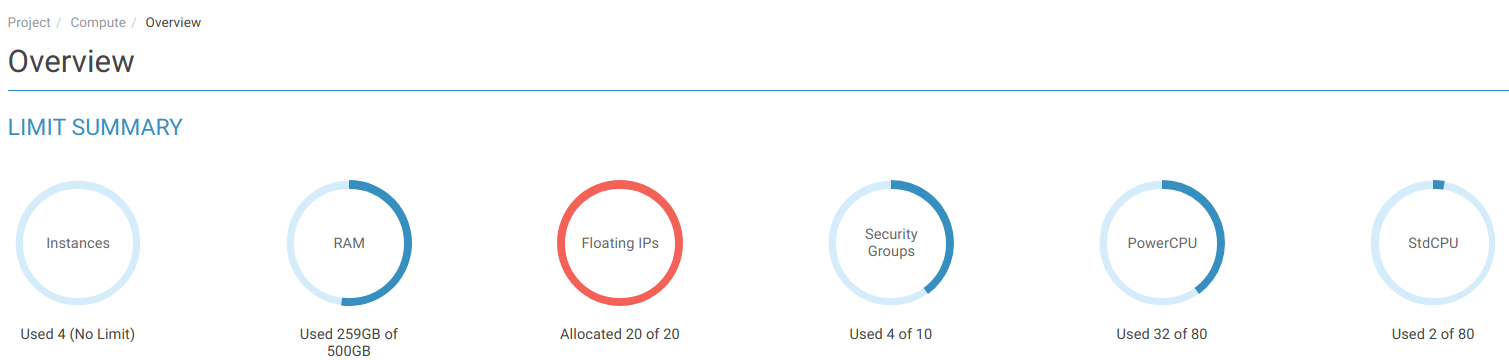
Power Flavors - vCPU (3.3 GHz) displayed as PowerCPUs.
Standard Flavors - vCPU (2.3-2.6 GHz) displayed as StdCPUs.